


NEW Guide to
COMMERCIAL
POSITIONING
Why contract manufacturers need a documented commercial position, and how AI now lets that position work at a scale that was not possible before.

No time to read now?
Why the unsung heroes of manufacturing are hard to see
Most contract manufacturers are not household names, and were never meant to be. Whether the customer is an OEM, a pharmaceutical sponsor or a brand owner, it usually prefers the arrangement kept quiet. Contracts carry confidentiality clauses, and programmes can run for years without a public mention.
That creates a specific commercial problem. In most B2B sectors, a supplier proves itself with named customers: a logo wall, a case study, a result with a number attached. A contract manufacturer often can show none of these. The work that best demonstrates its capability is the work it is least free to discuss.
So a buyer assessing you before a first conversation has less to go on than they would with almost any other kind of supplier. They have your website, your published material, what your people say in meetings and bids, and what others in the market say about you. Those sources carry most of the weight, because little else is available to carry it.
This is why positioning matters more for contract manufacturers than for most businesses. When proof points cannot be named, how a company shows up commercially is the proof. A clear, consistent case for choosing you, evidenced in ways that respect your NDAs, is what allows a buyer to form a view of you at all.
The rest of this guide sets out why that has grown harder, how buyers now decide, and how to build a position that holds up across a buying committee.
What has changed
Capability across contract manufacturing has converged. More suppliers now hold the same equipment, the same accreditations and the same quality systems. That serves customers well. It also means a capability that set a supplier apart a decade ago is now a line on many competitors' websites.
The market keeps growing. BCC Research projects contract manufacturing to reach USD 686.4bn in 2025, rising to USD 968.7bn by 2030, at a compound annual growth rate of 7.1%. Growth brings more credible suppliers into each tender, not fewer.
What has changed less is how suppliers describe themselves. Most present the same evidence in the same order: equipment lists, certifications, sectors served, a commitment to quality and on-time delivery. The Dentsu B2B Superpowers Index found that 68% of buyers say the suppliers they evaluate all sound and act the same, up from 60% two years earlier.
When capable suppliers converge and describe themselves in the same terms, a buyer has few ways to tell them apart. Price is the variable that remains, and competition on price tends to feed itself: suppliers cut to win work, buyers learn to expect it, and switching gets easier for everyone. The Commoditisation Trap sets out that cycle in full.
The cost is higher than it looks. McKinsey analysis found that, on average, a 1% price increase translates into an 8.7% increase in operating profit, assuming no loss of volume. Run the same arithmetic in reverse, and a 1% price concession at the same volume costs the same share. Bain's 2025 commercial excellence research points the other way: businesses confident enough to hold or raise prices achieved a 3-percentage-point margin premium.
What separates those two outcomes is usually whether a buyer can see and defend a reason to pay for the capability on offer.
How buyers decide now
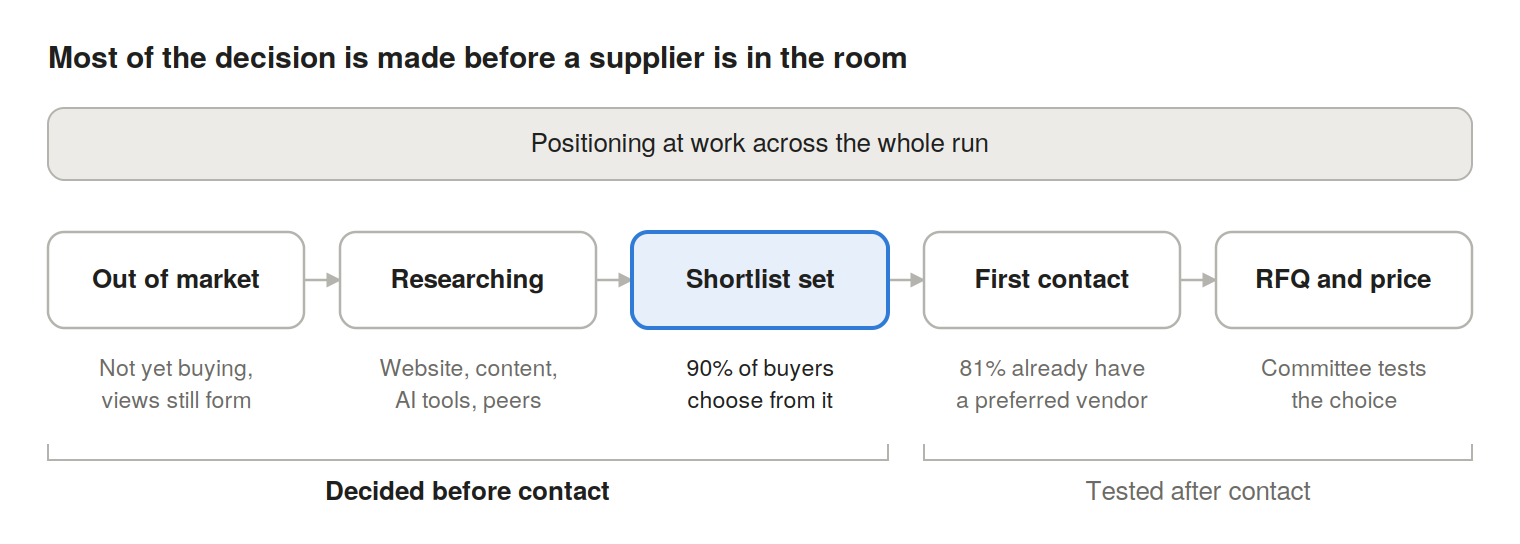
Most of the decision about a supplier is made before that supplier is in the room.
Research by Bain and Google, reported in Harvard Business Review, found that 90% of B2B buyers choose from a shortlist formed before formal evaluation begins. 6sense found that 81% of buyers have already picked a preferred vendor by the time they speak to sales. The shortlist is where the real decision sits, and it forms from what buyers can find, read and hear before they ask anyone for a quote.
The people forming that shortlist are rarely one person. A contract manufacturing decision usually runs through a buying committee: quality, procurement, technical and finance, often with regulatory affairs, programme management and leadership alongside. Each weighs a supplier differently, and each can rule one out alone. A position that persuades the technical lead but gives procurement nothing to compare, or gives quality no evidence to audit, will not survive the committee.
What the committee is looking for is reassurance. Dentsu's B2B Superpowers Index, drawn from more than 16,000 interviews, found that "I feel safe signing a contract with them" was the top buying driver three years running. Rory Sutherland, vice chairman of Ogilvy UK, puts the point directly:
"A lot of marketing isn't desire creation, it's reassurance." Rory Sutherland, speaking on the Attributed podcast
The same lesson shows up in how customers talk about manufacturing partners. Writing about electronics for EMSNow in October 2026, Philip Stoten described customers who have learned that:
"the cheapest option is rarely the most resilient one" Philip Stoten, EMSNow
A buyer who thinks this way still has to defend the choice to the rest of the committee. A clear position gives them the case to do it.
How buyers research is changing too. McKinsey reports that around 29% of B2B buyers now begin their research with AI tools rather than traditional search. Those tools assemble a view of each supplier from what is published about it. Where a supplier's value is written down clearly and consistently, it carries through. Where it is not, the supplier is summarised in the same terms as everyone else.
What commercial positioning is
Commercial positioning is the documented, evidenced case for choosing you: who you are for, why they choose you over the alternatives, and the proof behind each claim.
The idea is older than most people assume. Al Ries and Jack Trout set it out in Positioning: The Battle for Your Mind:
"Positioning is what you do to the mind of the prospect." Al Ries and Jack Trout
A buyer forms a view of your business whether or not you shape it. Positioning is the decision to shape it on purpose, with evidence. For a contract manufacturer, three qualities define a commercial position.
It is specific. It names the customers, sectors and programmes where you create the most value, and by implication those you are less suited to.
It is evidenced. Each claim is tied to something a buyer can check: a certification, a process, a capability, a track record described within the limits of your NDAs.
It is written down and agreed. The case for choosing you does not depend on who is in the room on the day. Sales, engineering, quality and leadership work from the same version of it.
How it differs from branding and messaging
Branding is how a position shows up visually and verbally: identity, design, tone. Messaging is the words used in a particular channel or conversation. Both depend on the position underneath. Without one, design has nothing to express, and messaging drifts from writer to writer.
The expertise that wins your contracts usually exists already. It sits with your engineers or scientists, programme managers, quality leads and leadership, and it is rarely written down in one place. Positioning work is largely the job of drawing it out, testing it and recording it.
Why now
Until recently, a documented position had limited reach. It lived in a strategy deck. Whether it shaped what a buyer saw depended on every writer, salesperson and bid manager remembering it and applying it well. Across a website, a sales team and several regions, that is hard to sustain.
Two changes alter the picture.
The first is AI in content production. Teams can now produce far more material, far faster, and that cuts both ways. AI working from a generic brief produces generic output at volume, which adds to the sameness buyers already report. Equinet's State of AI in Manufacturing report found only 16% of manufacturers currently seeing measurable returns from AI. Speed without a documented position behind it tends to repeat the problem faster.
The second is that the systems many commercial teams run on can now read a position directly. HubSpot's context layer lets a business hold its positioning, proof points and technical documentation as structured content that informs what its AI agents and tools produce, from web pages to sales emails. A position compiled in that form shapes output consistently across channels, instead of relying on each person who writes.
Together, these make it possible to apply one agreed position across everything a business publishes and every sales conversation it supports, at a volume no team could manage by hand. That is why we built the Commercial Intelligence Engine, launched in October 2026. It is a new approach, and it became buildable only through recent changes to HubSpot's platform.
The prerequisite has not changed. A system can only apply a position that exists, which is why the work in the next section comes first.
Working it through in four parts
Step 2 of the Commercial Intelligence Engine works through positioning in four parts, and the same structure works as a way of thinking it through, whoever runs it. Each part produces something the next one depends on.
1. Where you stand
Start with a baseline before designing anything. Two views matter: how your own team sees the position today, and how you actually present against the suppliers you meet in tenders.
Collect the first through a short questionnaire to leadership, sales and technical teams. Differences between their answers are findings in their own right.
For the second, read your website, capability statements and recent bids alongside those of four or five competitors. Note what each claims and what evidence sits behind each claim. Most markets show a cluster: quality, on-time delivery, responsiveness, and a list of equipment and accreditations. Note where you sit inside that cluster, and where you hold ground a buyer would struggle to find elsewhere.
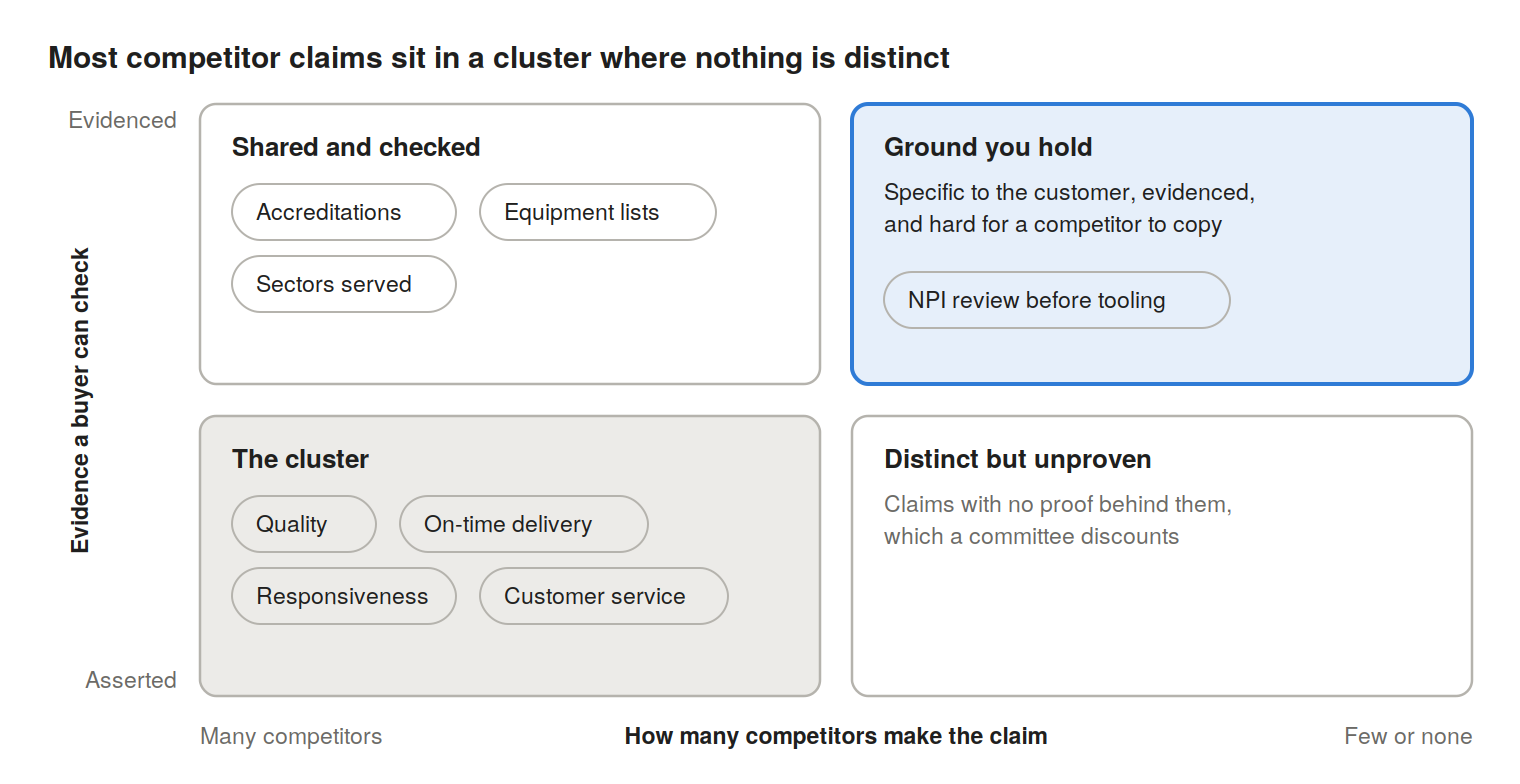
What it produces: a documented starting position, and a competitive picture of where you are distinct and where a buyer would struggle to tell you apart.
2. Who you are for
"The essence of strategy is choosing what not to do." Michael Porter, "What Is Strategy?", Harvard Business Review
For a contract manufacturer, that means being clear which customers produce profitable growth, and which absorb capacity without it.
Define a customer profile for each sector you serve: company size, programme type, volumes, regulatory environment, geography, and the kind of relationship that works for both sides. Base it on the customers you want to win as well as the ones you have, because a current customer base can reflect history more than intent.
Then map the buying committee behind each profile. For each role, record what it is accountable for, what it needs to see before it will support a decision, and where it would rule a supplier out. In a CDMO decision, for example, quality and regulatory affairs may each be able to stop a technology transfer, while finance weighs the cost of a delayed submission as heavily as the price.
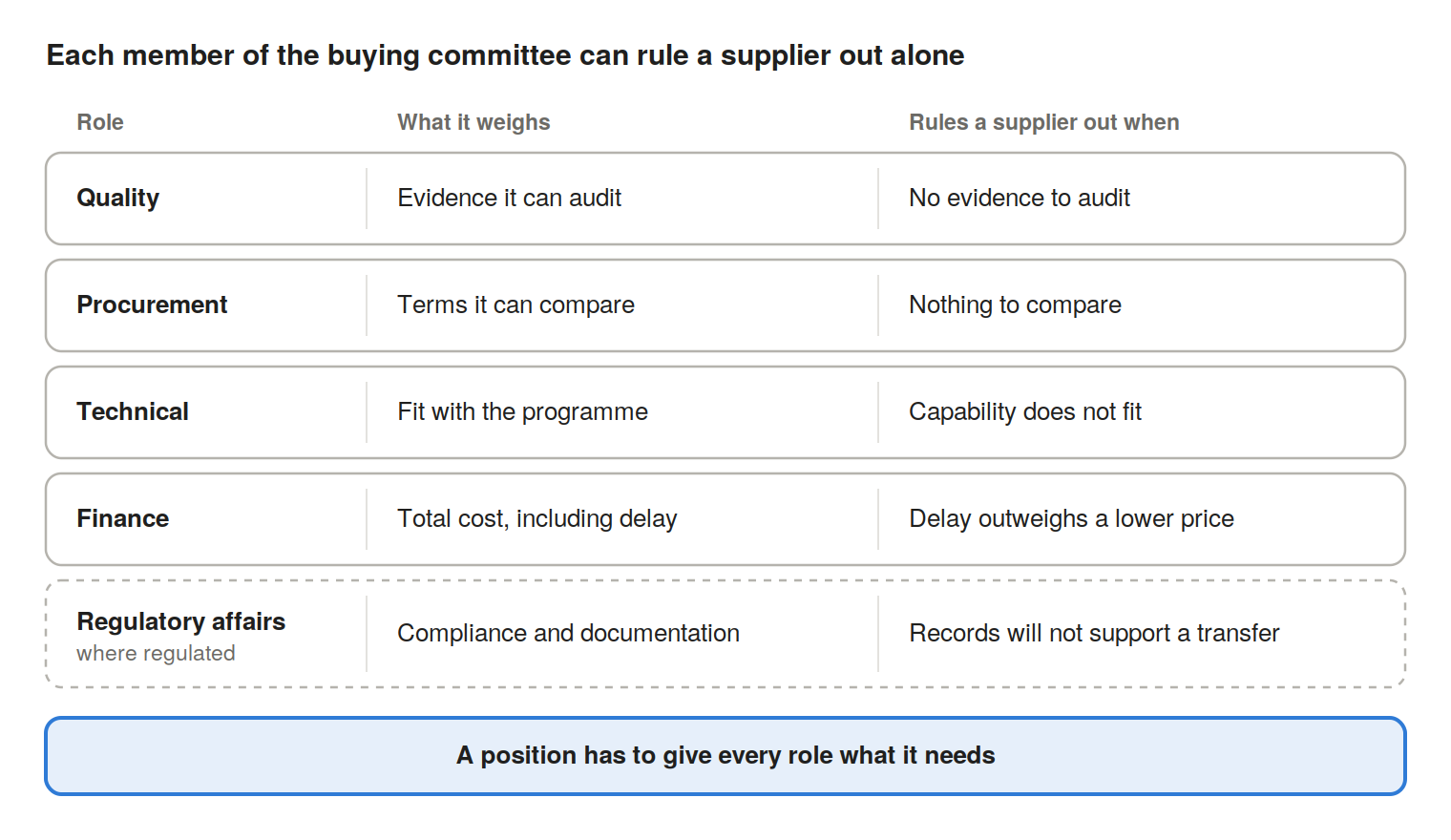
What it produces: defined customer profiles with the committee mapped behind each, the criteria suppliers are judged on, and the points where one gets ruled out.
3. Why you are chosen
This is where technical fact turns into commercial argument. An ISO 13485 cleanroom or a five-axis machining centre is a fact any competitor with the same assets can list. What that capability lets a customer do, and which risk it removes for them, is far harder to copy.
Clayton Christensen's jobs to be done thinking is a useful starting point: customers take on a supplier to make progress on a specific job. An OEM moving an electronic product from prototype to volume, for instance, needs manufacturability problems found before tooling is committed. The value proposition canvas, developed by Strategyzer, sets those jobs, and the pains and gains attached to them, against what you provide.
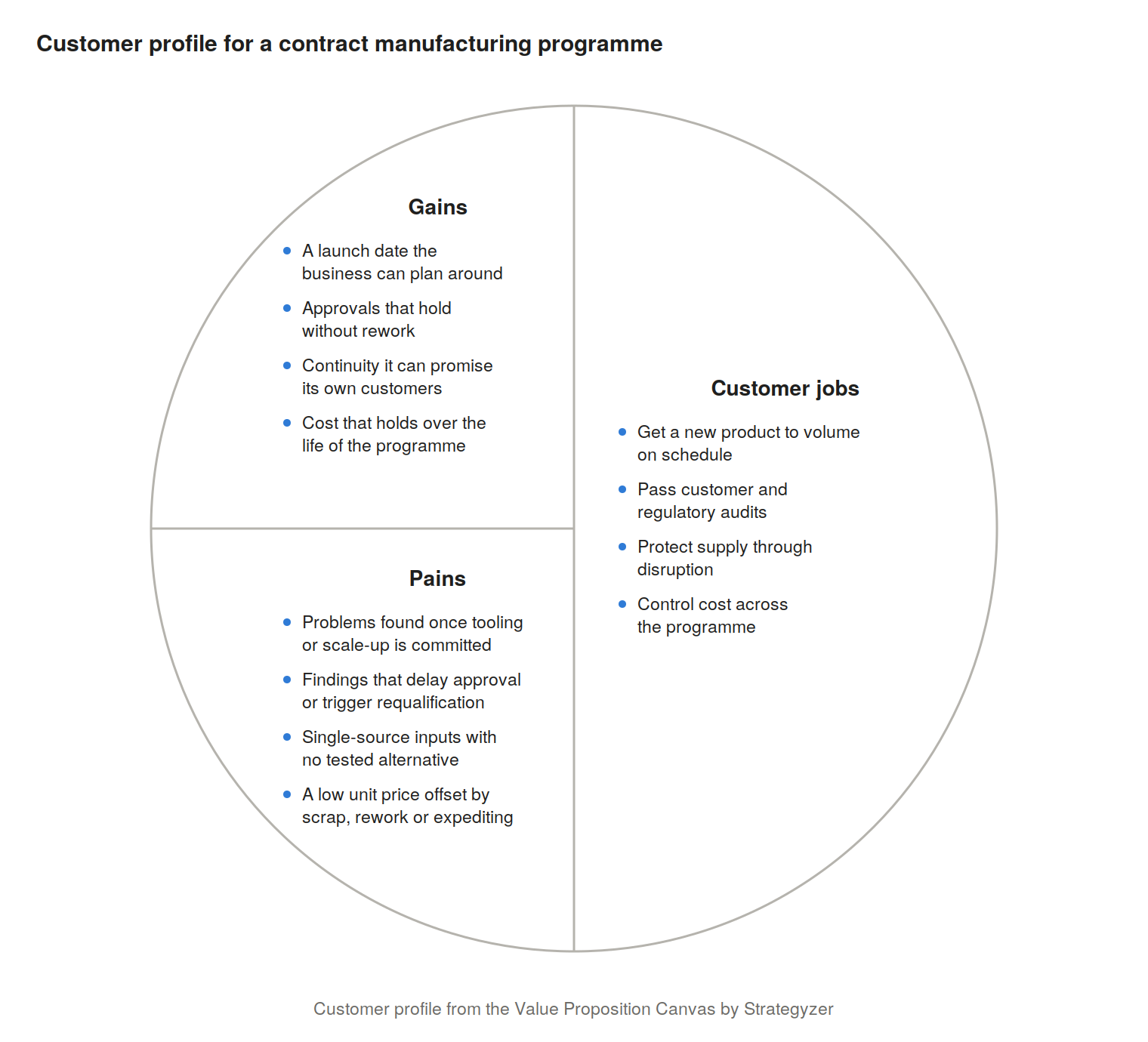
Then take each capability up three rungs: the fact, what it lets the customer do, and the risk it removes. The top rung is where a claim stops being shared with competitors.
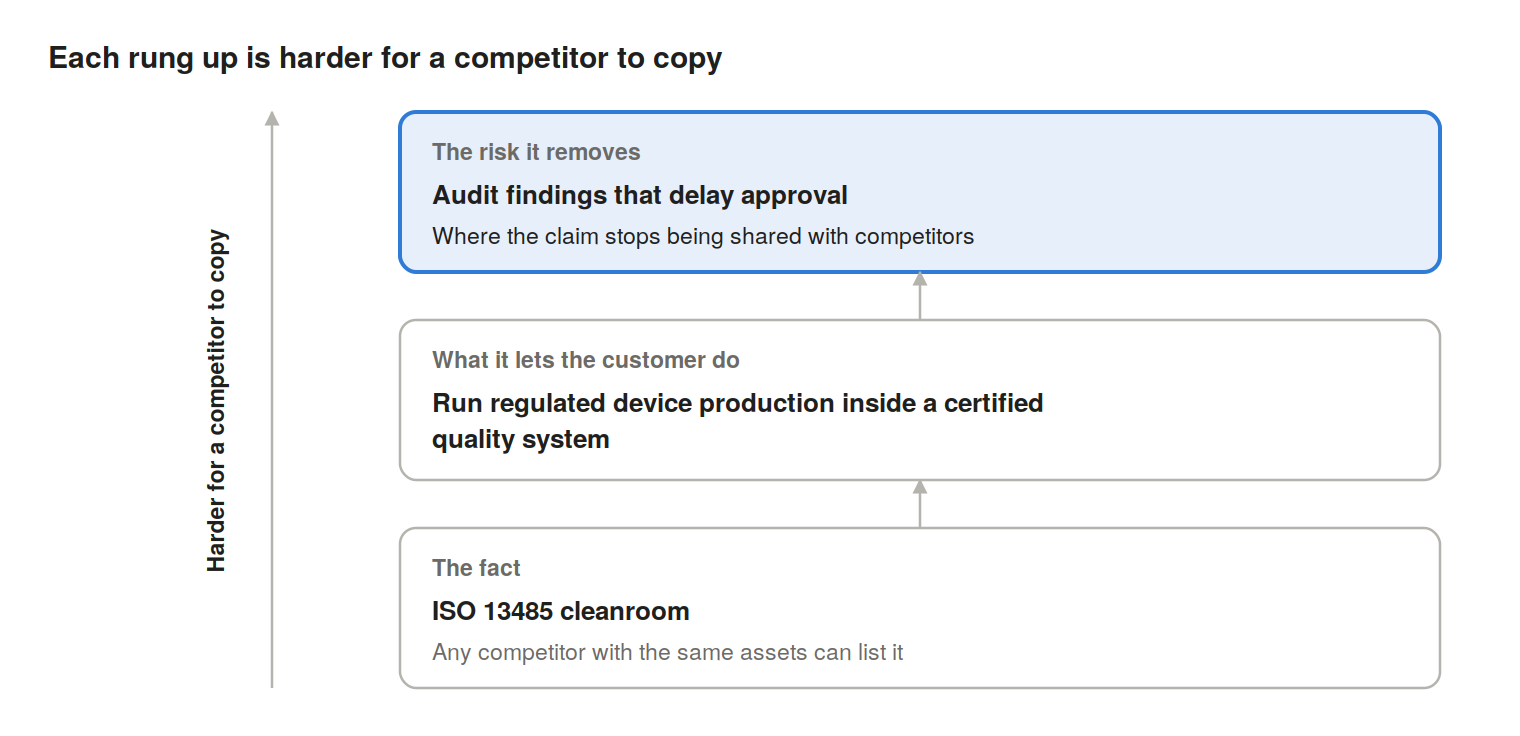
Finally, distil the result into a positioning statement. Graham Robertson describes four elements: who you serve, where you operate, where you will win, and why a buyer should believe you. The statement is an internal reference, used to check everything else against, and is not published as written. A fictional example:
For European medical device OEMs taking new products from development into volume, [Company] is a contract manufacturer organised around new product introduction. Its engineers review designs for manufacturability before tooling is committed, inside an ISO 13485 quality system, so late changes surface while they are still inexpensive to make. Customers can verify this through audit records and NPI gate documentation shared under NDA.
What it produces: a positioning strategy, a value proposition for each customer profile, one commercial narrative the whole business works from, and a documented tone of voice.
4. How it gets used
A position only holds if the people who sit in front of buyers understand it well enough to defend it in a live conversation. Gartner research found that around 70% of buyers find contradictions between what a supplier's website says and what its salespeople say. Each one gives a committee member a reason to doubt.
Work with sales and business development directly. Test the position against the objections they hear and the questions they cannot yet answer with evidence.
Then attach proof to every claim. For a contract packer handling chemicals, that might mean the accreditations, dangerous goods approvals and audit history a customer's compliance team will ask for before it signs off. Gather the documentation the business already holds, including specifications, certifications, regulatory approvals and the standards the work runs inside, and compile it with the position as structured content rather than a slide deck. That form serves people now and the systems described in the previous section.
What it produces: messaging and proof points with technical evidence attached to each claim, what the position now asks of your website and everything else you publish, and the position compiled in a form other systems can use.
Where to go next
A contract manufacturer's best evidence is often the work it cannot name. That makes the case it can make, written down, evidenced and applied consistently, one of the most valuable commercial assets it holds.
- Commercial Positioning: how Step 2 of the Engine runs, and what it produces.
- The Commoditisation Trap: why capable suppliers end up compared on price.
- Beyond the Shop Floor: the full case for running the commercial front office with the discipline of a production system.

We will send it to your inbox.

COMMON QUESTIONS
Resource Library


